01
AI-powered object detection
Vision models find vessels and other floating objects in day and thermal camera imagery, including targets that radar or AIS may not show clearly.
 ● BOW CAM · RGB · 12 TRACKED

SafeSea brings cameras, radar and AIS together into one intelligent picture of the traffic around your vessel, helping bridge officers recognise potential risks earlier and navigate with greater confidence.
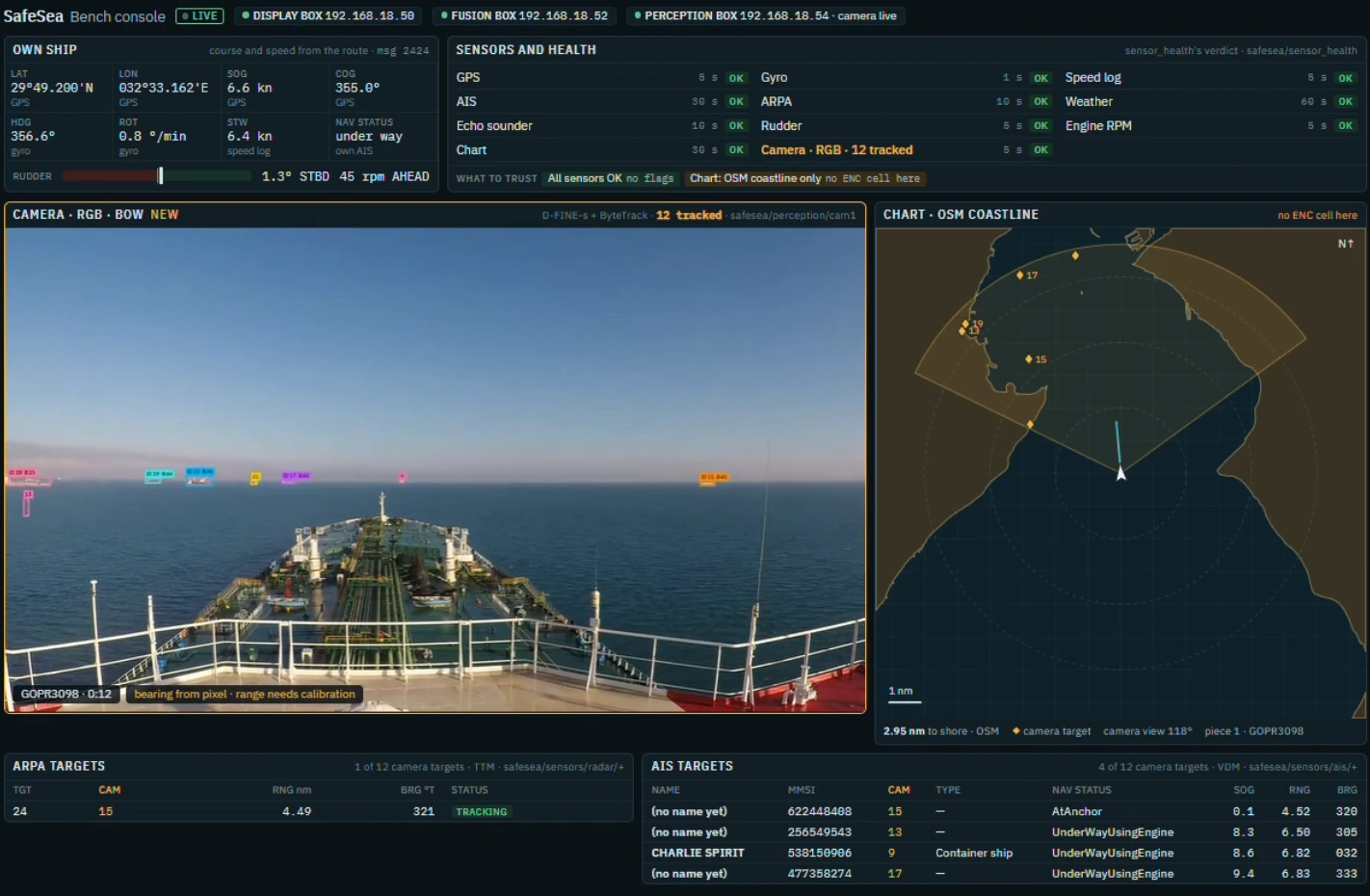
The SafeSea console
Captured from the SafeSea console replaying bow camera footage recorded at anchorage in Suez Bay. Own ship data, sensor health, camera detections, the chart and radar and AIS targets update together, frame by frame.
The challenge on the bridge
Officers on watch build their understanding of the traffic around them from several separate sources. Each one shows part of the situation, on its own display, with its own limits. Conditions change, targets close, and the work of joining it all up never stops.
Brings these together in their head, applies the rules of the road, and decides. Every minute, on every watch.
The SafeSea approach
SafeSea takes in what the ship’s cameras, radar and AIS already see, and associates it into a single track for each target. A vessel seen on camera, painted by radar and broadcasting on AIS appears once, with everything known about it in one place.
 Fusion
A vessel without AIS still appears when cameras or radar pick it up. A radar echo gains an identity when it matches an AIS report.
Instead of three symbols on three screens, each target has one identity, one history and one risk assessment.
The fused picture sits beside the equipment the bridge team already uses. It informs the watch and changes nothing about who is in command.
Platform capabilities
Seven capabilities work together as one system, from the pixel the camera sees to the encounter record reviewed ashore.
Vision models find vessels and other floating objects in day and thermal camera imagery, including targets that radar or AIS may not show clearly.
● BOW CAM · RGB · 12 TRACKEDCPA, TCPA, bow crossing range and bow crossing time are computed continuously for every tracked target.
| Target | Brg | Rng | CPA | TCPA |
|---|---|---|---|---|
| T-014 | 061° | 3.4 | 0.42 | 06:18 |
| T-019 | 191° | 2.1 | 0.90 | 21:40 |
| T-012 | 331° | 4.8 | 1.60 | 14:02 |
Each detection becomes a track with a stable ID and motion history, held from frame to frame as the situation develops.
Camera tracks, radar and ARPA targets and AIS reports are associated, so each target appears once with every source that sees it.
 CAMRADAIS
Each encounter is classified as head-on, crossing or overtaking, and own ship’s role as give-way or stand-on vessel is shown.
Alerts are raised as risk develops and kept calm until it matters, with clear acknowledgement on the bridge. Try acknowledging one.
Encounters are recorded with synchronised camera, radar and AIS data, ready for review on board or ashore.
Technology
Computer vision, multi-target tracking and sensor fusion feed a risk engine that speaks the language officers already use: CPA and TCPA, bow crossing range and time, and the encounter situations defined by the COLREGs.
Vision models detect vessels and other objects in day and thermal imagery.
Each object keeps a persistent identity and motion history from frame to frame.
Camera tracks are associated with radar and ARPA targets and AIS reports.
CPA, TCPA, BCR and BCT are computed and read against the COLREGs encounter type.
The bridge is alerted as risk develops, and each encounter is recorded for review ashore.
SafeSea does not steer the ship. It gives the officer on watch a clearer picture, earlier.
It is not an autonomous navigation system and it does not replace the lookout, the radar or the judgement of the bridge team. Decisions and command stay with the officers on the bridge.
Solutions
The same fused picture that supports the officer on watch can give shore teams a clear view of how encounters unfold across a fleet.
Add a consistent layer of situational awareness to every bridge, supporting the officers trusted with the vessel, its crew and its cargo.
Give superintendents and safety teams recorded encounters with synchronised sensor data, useful for incident review, navigational audits and training.
Follow traffic situations across the fleet from shore and see where and when close-quarters situations tend to develop.
A structured record of what the bridge could see during an encounter can inform loss-prevention work and the risk conversation with members.
Company
SafeSea exists for one outcome, written into our name and our campaign line: every ship, home safe. The way we build the platform follows from that.
Request a demo
See how SafeSea can bring greater awareness and confidence to your bridge operations. Tell us about your fleet and we will set up a walkthrough of the console.